


The IP First Response chatbot is an experimental free tool that lets you ask questions about intellectual property (IP) disputes in plain English and get relevant, Australia specific information back. No jargon, no gatekeeping, and hopefully, no stress.
This page explains how it works, what it draws on to answer your questions, and just as importantly, what it cannot do.
It's a librarian, not an IP expert
Most AI tools you might have used, like ChatGPT, are trained on information from across the entire internet. While that makes them great at writing poems about cats, it can make them pretty unreliable for legal information. Sometimes they can fabricate information but present it as a fact (known as “hallucinating”) or provide you information that’s not quite correct, like answering your question based on another country’s laws.
Using this type of AI as a starting point, we have augmented how it works using an approach called Retrieval Augmented Generation (RAG).
To understand this approach, it helps to think of the chatbot as a very fast librarian. When you ask a question, it doesn't just create the answer based on the information it was trained on. Instead, it turns around, grabs a specific couple of ‘books’ from a curated shelf, reads them, and then summarises what it found for you.
These "books" are:
- IP First Response content: These are plain-language pieces of information about IP enforcement options in Australia, written specifically for people navigating IP disputes without a legal background. This information makes up the majority of the chatbot’s shelf/library.
- IP Australia web pages: A curated selection from IP Australia's public website, included to cover foundational questions that the IP First Response content alone might not fully answer.
The chatbot doesn't have access to the open internet. If the answer isn't on our shelf, it should tell you it doesn't know.
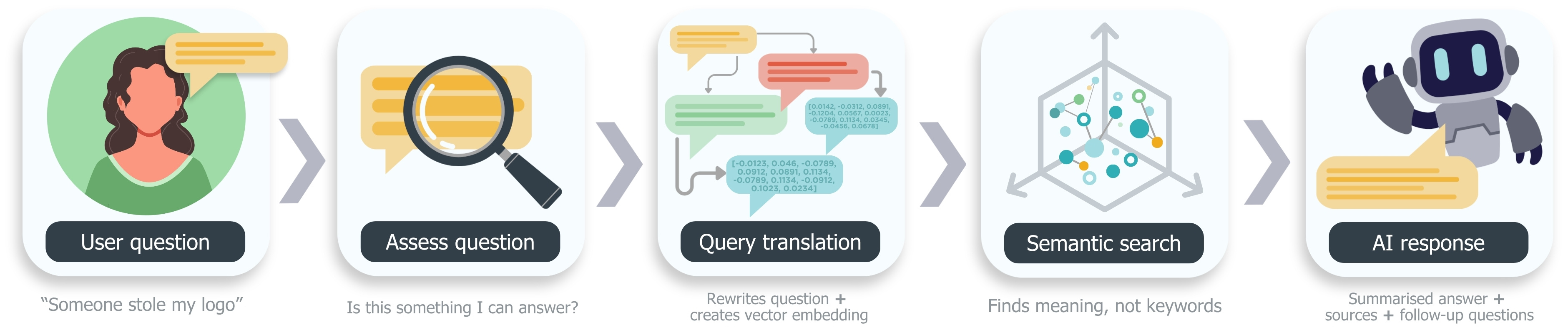
When you type a question, a few things happen in the background:
- Your question is interpreted: The system checks whether your question falls within the range of information it’s expected to respond to or if it needs more information before it can conduct an effective search. As a result of this step, the chatbot may clarify that the request isn’t something it can help with, or it may ask follow-up questions to improve its search.
- Translating the vibe: If the system determines that your question is within its remit, it will then rewrite your query in a few different ways and subsequently turn those re-written questions into a long string of numbers. These numbers mathematically represent the meaning of what’s being asked (called a vector embedding). This helps the computer understand the intent and meaning of your question, not just the specific words you used.

- The search: The AI then uses these number strings to search our library for the most relevant information, measuring the meaning of the user’s query against the meaning of each of the webpages. So, it doesn’t look for similar keywords, it looks for similar meaning using some fancy maths.
- The summary: We use an AI model from Anthropic, hosted securely in Australia with Amazon Bedrock, to read the retrieved information and write a response that answers your query while adhering to guidelines we’ve set. For example, one of these guidelines is for the system to anticipate and pre-write some useful follow up questions for the user to select. It also links to the exact pages it used to generate the answer so you can check the facts yourself.
Your privacy is baked in
We know that talking about IP disputes can feel private, especially if you think you might be in the wrong. That’s why we have made sure to design a system that can help you feel comfortable by not unnecessarily requiring or retaining your private information.
You don't need to create an account or tell us who you are to access information about the complexities of the IP system.
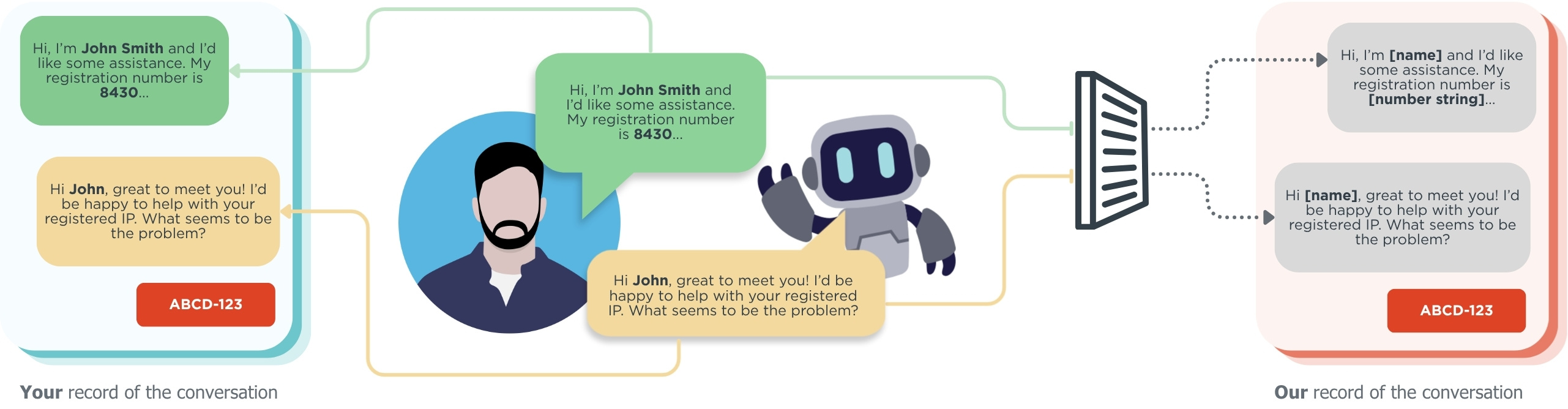
- No memory between sessions: The chatbot is stateless. Once your session ends, nothing from that conversation is retained in your web browser. If you want to keep your conversation, make sure to download it!
- Cleaning and storing: Before your conversation is stored, it is run through a filter which uses an algorithm to detect and remove the most common types of personally identifiable information like IP registration numbers and email addresses. This gives us useful information to help us improve the system without storing your personal information when we don’t need it.
- Onshore storage: Interaction data is held in Australia, protected by access controls, audit logging, and encryption. IP Australia does not sell or share your data.
You can read more about your privacy, rights and how your data may be handled in the Chatbot Privacy Statement.
A few more things to keep in mind
We've tested the chatbot extensively with real business owners and subject matter experts, refined the responses, and built safeguards against the most common failure modes. But it's also an imperfect solution, far from reaching its full potential on day one. As people use the tool, we'll be sure to keep iterating based on what we learn.
If a response seems off, misleading, or unhelpful, there's a feedback option at the bottom of each response. Please use it. It directly informs how we improve the system.
Of course, if you'd prefer not to use a chatbot at all, that's completely fine. The IP First Response navigator offers a more structured, filter-based way to explore your enforcement options, with no AI involved.
A quick note on why we are doing this
IP First Response is a platform created to demystify the complexities of protecting Australian IP. By making this information more accessible and easier to find, we hope to give small businesses the confidence to protect what they have built, enabling all Australians to benefit from great ideas.
If you’ve got further questions about the chatbot or the IP First Response platform please reach out to our inbox or give our call centre a ring(Opens in a new tab/window).