


This blog was authored by lawyer Sinth Jegaskanda (PhD, MIP, MBA, GAICD), Head of Intellectual Property at Murdoch Children’s Research Institute & Content Creator @Imagine IP(Opens in a new tab/window). The views expressed do not necessarily reflect the views or position of IP Australia, and should not be taken as constituting advice. If you require guidance specific to your situation, you should consider seeking professional advice.
The imagery for this blog has been created by Sinth Jegaskanda using AI. LEGO® is a trademark of the LEGO Group of companies which does not sponsor, authorise or endorse this site. Imagine IP and IP Australia do not advertise or sell LEGO® products.
How sharing IP rights could paralyse your business & destroy value in technologies

Imagine this, Dr Sussie Singh was like any other Australian academic researcher working at an Australian university, brilliant at her craft but struggling to fund it. Despite pioneering breakthrough techniques for molecular scaffolds in cancer immunotherapy, grant rejections were rapidly piling up. Then came a chance encounter at an international conference that changed things for the better.
After her presentation, Gerald Marintez, Chief Scientific Officer of a promising biotech startup, Gravity Bio Pty Ltd, approached with an exciting proposition. His company had developed novel targeting molecules that could be revolutionary when combined with Dr. Sussie’s scaffolds. “We could fast-track both our technologies”, he said over coffee. “Let’s set up a research collaboration.”
Six months later, the University and Gravity signed a collaboration agreement with joint ownership of any IP developed from their combined work. It seemed perfectly fair and utilitarian, both parties planning together, and contributing equally. The collaboration thrived: Dr. Sussie secured funding to advance her research program, while Gerald’s company accessed university resources and technology that accelerated their R&D pipeline.
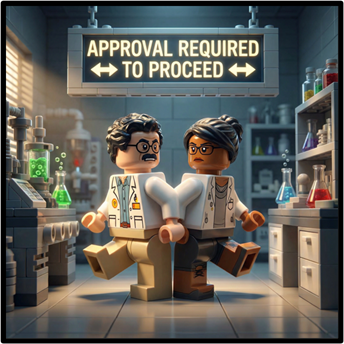
Then came the difficult part… a major pharmaceutical company wanted to license the combined technology. But joint ownership meant both parties needed to consent. The University wanted better terms and broader research access. Gerald’s investors wanted better deal terms. Neither could move without the other’s approval.
A promising technology sat frozen; now once a promising endeavour became a painful and expensive exercise with lawyers. This is when the hidden pitfalls of joint IP ownership surface, issues that only become apparent when either party tries to exploit the combined work.
The win-win of collaborative research and development
The saying “two brains are better than one” captures how collective thinking generates superior ideas and solutions1. Diverse teams consistently produce more innovative and higher quality outcomes2,3. Game theory demonstrates that collaboration between parties often yields better results than competition, particularly when resources are finite. Companies collaborating on research can share costs and achieve mutually beneficial outcomes4.
Australian innovation has thrived on industry-academic partnerships. Programs like the National Health Medical Research Council (NHMRC) Development grants, Australian Research Council (ARC) Linkage Program, Cooperative Research Centres (CRC) and Industry Growth Centres actively encourage collaborations that leverage resources from both sectors. The CSIRO Report on Commercial outcomes of SME-Research collaboration highlights that of 201 of respondent businesses 159 received financial support to engage in collaborative R&D programs with University and Research Institutes over the past five years4.
National principles of intellectual property management promote equitable IP sharing arrangements, often resulting in co-ownership of IP generated through collaborative work6. The underlying principle is that creators and institutions should benefit from IP created using publicly funded research.
This seemingly fair approach, however, conceals significant pitfalls that emerge during commercialisation; problems that Dr. Sussie and Gerald were about to discover.
The David and Goliath style battle for agreement

IP ownership terms are typically defined in agreements (such as collaborative research agreements or service agreements), which distinguish between “Background IP” (created prior to or independently of the project) and “Project IP” (created during and for the collaboration)6. In Dr. Sussie and Gerald’s case, her molecular scaffolds and his targeting molecules were Background IP, and each needed rights to use the other’s pre-existing technology.
The real battle is around the ownership of the Project IP created during the collaboration.
Negotiations around IP ownership often consume more time and resources than the research itself! Small companies face significant disadvantages when negotiating against large organisations like universities with experienced business development staff and legal teams. With limited budgets and fee-for-service lawyers billing by the hour, startups watch the meter run and often concede on IP terms to get deals done quickly.
In my experience, the outcome is usually joint ownership. In practice, organisations rarely understand what joint ownership actually means for their rights to commercialise the technology.
What does joint-ownership mean?
Joint ownership sounds pretty fair on paper, however, in practice it creates different complications for different types of IP7.
Patents
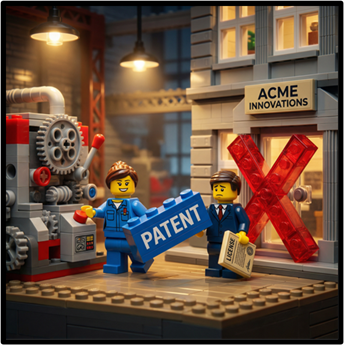
Under Australian law, inventors who create the invention are the first owners. Typically, employees assign their rights to their employer through employment contracts and IP policies8. When inventors come from multiple organisations, each assigns rights to their employer, and the collaboration defines the final ownership structure.
Without specific agreement, parties own the patent in equal shares and can exploit it independently without accounting to the other. However, neither can license the patent or assign their interest without the other’s consent.
This creates asymmetric exploitation rights. Gravity Bio Pty Ltd could manufacture and sell products using the jointly owned patent. But the University couldn’t license its share to another biotech company because doing so would create a competitor for Gravity, requiring their consent, and possibly could never be granted.

Copyright
Joint copyright ownership arises when multiple authors collaborate on creative works like research reports, documentation or software code. Each party can use the copyright material but cannot license it to third parties without unanimous consent9. If Dr. Sussie and Gerald’s teams co-authored crucial protocols or developed software together, neither could freely share or license these materials to others without mutual agreement, limiting both parties’ ability to leverage the work commercially.

Know-How
Know-how presents unique challenges in joint ownership. Unlike registered IP rights, trade secrets and technical expertise are protected through confidentiality. When both parties contribute proprietary techniques or processes, determining boundaries becomes murky. Neither party can exploit the confidential information without accounting to the other joint owner for any of the profits. Like copyright and patents, neither party can license or assign their rights to another party without the consent of the other joint owner. The uncertainty around jointly-owned know-how often prevents both parties from effectively deploying their collective expertise in new projects.
Illusion of fairness
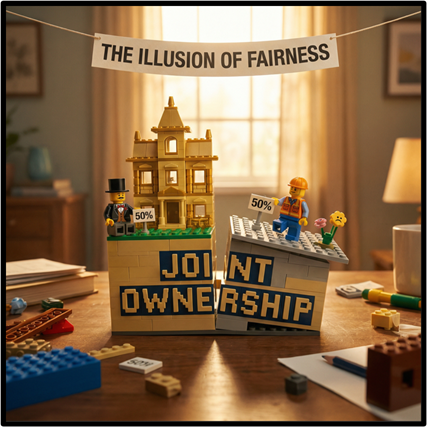
Joint ownership seems fundamentally fair for collaborators sharing development efforts. But fairness without clear expectations can be a recipe for disaster.
Many parties assume commercialisation details can be negotiated later in a separate agreement. This is precisely where value gets destroyed. When Dr. Sussie and Gerald couldn’t agree on licensing terms, their breakthrough technology sat unused while competitors advanced.
Parties may consider the following safeguards if they are considering joint IP rights:
Designate a commercialisation lead upfront - especially when small businesses collaborate with larger organisations. One party should have decision-making authority or a low-cost pathway to reach a decision.
Separate ownership from commercialisation rights – joint owners can hold equity while granting one party exclusive commercialisation control.
Include explicit, exploitation rights – define how each party can independently use, license or assign their interest.
Maintain a joint IP register – document both Background IP and Project IP throughout the collaboration.
Where to now?

After nearly a year of deadlock, Sussie’s University and Gravity Bio Pty Ltd finally entered into a commercialisation agreement. The negotiation was painful, with lawyers billing hours, term sheets redrafted, and comprise after painful comprise.
By the time they signed, the pharmaceutical company had moved on. Market conditions had shifted, and a competitor had launched a similar therapy.
The final agreement gave Gravity Bio commercialisation rights with revenue-sharing provisions for the University. Better than nothing, but far from the transformative outcome they had envisioned when they first shook hands at that conference.
Dr. Sussie continued her research with modest royalty hopes. Gravity Bio pivoted to other projects, having burned through critical funding and momentum during the IP stalemate.
This wasn’t the best outcome for either party, but this reflects the hidden tax that joint IP ownership extracts from innovation, not in legal fees alone but also in lost opportunities, vanished partnerships and technologies that never reach consumers that need them.
The real cost of joint ownership isn’t what you negotiate. It’s what you lose while negotiating.
Thanks for reading, and as always, keep imagining.
References
Riedl C, Kim YJ, Gupta P, Malone TW, Woolley AW. Quantifying collective intelligence in human groups. Proc Natl Acad Sci U S A. 2021 May 25;118(21):e2005737118. doi: 10.1073/pnas.2005737118. Erratum in: Proc Natl Acad Sci U S A. 2022 May 10;119(19):e2204380119. doi: 10.1073/pnas.2204380119. PMID: 34001598; PMCID: PMC8166150.
García Martínez, M., Zouaghi, F., & Sánchez Codina, A. (2017). “Diversity is strategy: The effect of R&D team diversity on innovative performance.” R&D Management, 47(5), 674–689. https://doi.org/10.1111/radm.12244(Opens in a new tab/window)
van Zijl AL, Vermeeren B, Koster F, Steijn B. Functional diversity and team innovation: A study on the mediating role of social cohesion in primary care teams. Health Care Manage Rev. 2023 Jul-Sep 01;48(3):229-236. doi: 10.1097/HMR.0000000000000369. Epub 2023 Mar 27. PMID: 36971509; PMCID: PMC10227926.
Verreynne M., Torres de Oliveira R., (with contributions from Mcgillivray H., Nguyen T., Oliveira Silva M., Shepherd E. and Feast G.) (2025) Commercial outcomes of SME-Research collaboration. CSIRO, Australia.
Australian Research Council (ARC) & National Health and Medical Research Council (NHMRC). (2013). National Principles of Intellectual Property Management for Publicly Funded Research. Canberra: Australian Government. https://www.nhmrc.gov.au/about-us/resources/national-principles-ip-management-publicly-funded-research(Opens in a new tab/window)
IP Australia. (n.d.). IP Management For Collaborations. Retrieved February 15, 2026, from https://www.ipaustralia.gov.au/manage-my-ip/how-to-commercialise-my-ip/commercialisation-and-collaboration/ip-management-for-collaborations(Opens in a new tab/window)
Queensland Government, Department of State Development, Infrastructure, Local Government and Planning. (n.d.). Your rights as a joint owner of intellectual property. Queensland Government Business and Industry Portal. Retrieved February 15, 2026, from https://www.business.qld.gov.au/running-business/risk/ip/ip-kit/browse-ip-topics/your-rights-as-a-joint-owner-of-intellectual-property(Opens in a new tab/window)
Patents Act 1990 (Cth) s 15(1).
Copyright Act 1968 (Cth), s 35(6); Cescinsky v George Routledge & Sons Ltd 2 KB 325.
Hall, A. (2025, December 14). Legal Conflicts Over Jointly Created Trade Secrets. Aaron Hall, Attorney. Retrieved February 15, 2026, from https://aaronhall.com/legal-conflicts-jointly-created-trade-secrets/(Opens in a new tab/window)