


This blog was authored by Senior Associate Louise Brunero & Director Jeff Bergmann, IP Commercialisation Lawyers at law firm Solubility(Opens in a new tab/window). The views expressed do not necessarily reflect the views or position of IP Australia, and should not be taken as constituting advice. If you require guidance specific to your situation, you should consider seeking professional advice.
What stops your competitors from taking your business, and where does IP fit in?
Having a great idea and a strong team is important—but it’s not enough on its own for business success. Success in business relies on staying competitive. Any one or more of the following can create practical barriers for new entrants in your industry.
- Red tape – Regulatory requirements such as licensing requirements, product approvals and data exclusivity arrangements can create major hurdles for competitors, especially in pharmaceuticals, agrochemicals, and food production.
- Government protectionism – Tariffs, trade restrictions, or quarantine rules can shield domestic industries from foreign competitors.
- Logistics – Access to reliable supply chains and distribution networks can be a significant advantage, particularly when dealing with perishable or temperature-sensitive goods.
- Land and Site Access – Securing a suitable location can be difficult in sectors such as mining, agriculture, or manufacturing, where operations depend on specific environmental or zoning conditions.
- Plant and Equipment – Specialised or expensive infrastructure such as advanced manufacturing facilities or processing plants can be hard to replicate.
- Financial Barriers – High start-up, compliance costs, and capital requirements, can deter new competitors.
- Other Factors – “First-mover advantage”, customer loyalty, and exclusive relationships with suppliers, distributors and resellers can also create barriers.
However, for creative and innovative businesses, and particularly those in start-up or early phases, your IP (if properly identified in the business and protected) is likely to be your strongest barrier to entry for competitors and your greatest asset. This is especially the case where the business deals in products that can be easily reproduced but have resulted from extensive development effort.
What types of IP might a creative and innovative business have?
At its most simple, IP is a “creation of the mind” with a “bundle of legal rights” attached. For a business, these “creations” can occur in your technology, designs, brands, software code, procedures, processes or research outcomes and can give rise to various IP rights such as patents, copyright, designs, trade marks, trade secrets/know-how, circuit layout rights and plant breeder’s rights. You can learn more about the different types of IP(Opens in a new tab/window) and how to protect them on the IP Australia website.
Different types of IP – what key features do they share?
The different types of IP serve different purposes to protect your creative output. For example, a patent can protect an innovative product or manufacturing process, while a trade mark can be used to protect the name/brand of the finished product and copyright can protect the source code of an algorithm.
There are also differences in the way the different types of IP protect your creative output.
- For a patent, the key feature is that you DISCLOSE the full details and best-known method for your invention in the patent application. In return you are granted exclusive commercial rights to your invention, basically a monopoly in the market typically for 20 years. Note that the disclosure occurs several years before any patent is granted.
- By contrast, the key feature of a trade secret is that it is KEPT SECRET and it can be protected indefinitely — so long as it remains secret.
- Initial registration of a trade mark is typically 10 years, but renewable indefinitely if properly used.
- Copyright generally lasts for the life of the author plus 70 years.
Despite these differences, all IP rights share some common features:
- IP rights are a national system so there is no “global” patent or trademark; and
- IP rights are a negative right, providing a “barrier to entry” to stop others from doing something which infringes the IP Right.
Challenges for business
While IP is a barrier to entry, an IP right is not a guarantee of validity. Anyone can challenge the validity of your granted patent or trade mark, or your claim to copyright or a trade secret.
An IP right does not provide a freedom to operate, rather it provides you with the right to stop others from using your creative output without your permission.
This has two consequences:
- you need to be prepared to protect, enforce and defend your IP; and
- remembering that IP rights are a national system (ie there is no “global” patent or trademark), you need to ensure that you have protected your IP and created the barrier to entry in those jurisdictions in which you wish to stop others.
How can IP add value to your business?
In the early stages, creative and innovative businesses must attract investors, and the best way to do this is to show investors that your business has a strong advantage that competitors cannot easily copy. A useful question to ask yourself is “Why would an investor choose to invest in, or buy, my technology, or someone pay me for a licence to use it, rather than copy it, develop it themselves or turn to a competitor?”
The answer lies in your business having foundational IP that is both:
- broad – capturing a big slice of the market; and
- strong – capable of stopping competitors from operating in your space.
How one brand leverages IP to maintain its competitive edge

Coca-Cola is an excellent example of a business successfully leveraging its IP to create an investable product that prevents copycat competitors.
So how much IP is there in a bottle of coke, and what can your business learn from Coca-Cola?
A bottle of Coke is protected by myriad patents, copyright, designs, trade marks, trade secrets/know-how. Also, circuit layout rights and plant breeder’s rights may protect aspects of the manufacturing process.
Below are just some of the IP barriers relied on by Coca-Cola to keep its global competitive edge in the soft drink market.
- Coca-Cola has more than 9,000 patent filings in numerous jurisdictions covering aspects of vending machines and packaging such as the tamper-proof features of bottle caps.
- Coca-Cola's formula is a tightly held trade secret. The company has relied on secrecy and robust internal policies to keep its recipe out of competitors' hands for nearly 140 years.
- The iconic contour design of the Coca-Cola bottle is instantly recognisable and has remained largely unchanged since 1915.
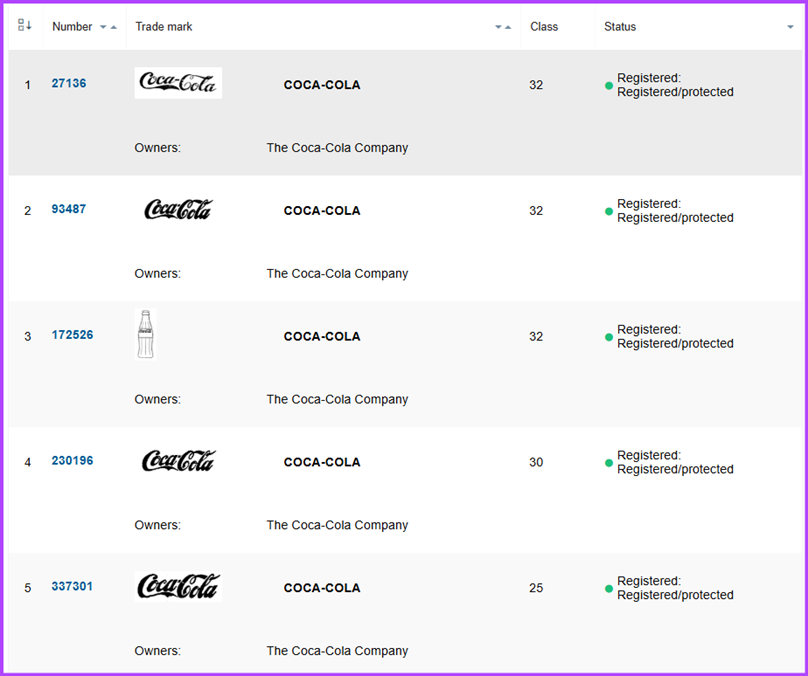
- Coca-Cola has strong brand recognition with the Coca-Cola script, red logo and the shape of the bottle all protected as trade marks in numerous jurisdictions.
Below is an extract of just the first five Coca-Cola trade marks returned on a search of the Australian trade mark register(Opens in a new tab/window) , dating back to February 1920.
- There is copyright in the artistic script of the Coca-Cola trade mark and in the various trade dress and packaging.
- Finally, while Coca-Cola doesn’t have circuit layout rights or plant breeder’s rights in the beverage or bottle itself, it’s likely to have circuit layout rights in various electronic components of its manufacturing equipment and may also have plant breeder’s rights for new sugarcane varieties or other plant ingredients in the (secret) recipe.
Steps your business can take
- Recognise your IP and protect it in the markets that count: Identify what IP is in your business, from patents and trademarks to copyright and trade secrets and be sure to seek protection of your IP in those jurisdictions in which you wish to stop others.
- Engage an expert: Knowing when to get the right advice is critical to support your business growth and goals.
- An IP commercialisation lawyer (that’s us) helps you structure your business and maximise the value of your IP ownership and commercial agreements. IP commercialisation lawyers focus on preventing disputes—think of us as “pre-nup lawyers” laying the groundwork for a long-term relationship, rather than the “divorce lawyers” you’d consult when things go awry.
- A patent or trade mark attorney handles the technical side of registering patents, trademarks and designs.
- Know the steps to enforce your IP or what to do if you are accused of infringing another party’s IP. This is where IP First Response’s navigator tool can help you understand your options to enforce your IP or defend an IP infringement challenge.
Final thoughts
Intellectual property (IP) acts as a barrier to entry, preventing others from exploiting your creative work. However, owning IP does not automatically give you the right to use it freely, nor does it guarantee “freedom to operate.” When investors, buyers, or licensees are interested in your IP, their main motivation is usually that the IP can block competitors from entering the market.
Think like Coca-Cola! Be sure to identify and protect your IP in the jurisdictions in which you wish to operate. The more IP rights you have and the broader their scope, the greater the barrier to entry for competitors and that’s attractive to potential investors, buyers and licensees.
Louise Brunero & Jeff Bergmann from Solubility(Opens in a new tab/window) are IP Commercialisation lawyers who work with creative and innovative businesses from start-ups to established companies and they share their thoughts on how IP rights are a barrier to entry and how IP can add value to your business.